
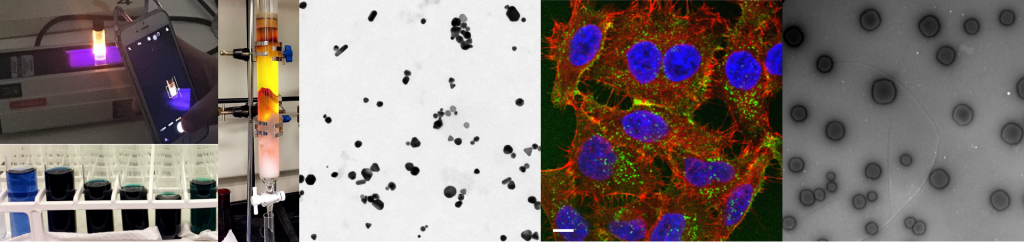
Our research in macromolecular and materials chemistry aims to develop fundamentally interesting new materials where structurally diverse polymers, dendrimers, and hybrid nanomaterials are rationally designed and synthesized, their properties are investigated, and their applications are explored in various fields of science and technology.
Polymer-Templated Synthesis of Metal Nanoparticles
Metallic nanomaterials have attracted considerable interest due to their unique optoelectronic properties. They are solid particles with at least one dimension between 1 and 100 nm. Because of their large surface area to volume ratio, they exhibit increased interaction with other molecules. In addition, their properties are quite different from their bulk counterparts because of quantum-size effects. Given these remarkable and fascinating characteristics, they are gaining significant attention in many fields, including biology, optics, electronics, and catalysis. For any given application, nanomaterials with shape- and size purity as well as high stability are of significant importance. In our group, we are interested in using polymers as templates to control the size, shape, and stability of metal nanoparticles. Advances in living polymerization methods have made it possible to synthesize polymers and block copolymers of well-defined chain lengths and architectures. We are actively investigating to translate this precision in size, topology, and dispersity from molecular size regime to materials in nano- and micro size scale as a means to fine-tune the optoelectronic properties of metal nanoparticles by designing Metallo-macromolecules as precursors to metallic nanoparticles.
Functional Block Copolymer- and Janus Dendrimer-Based Soft Materials
Linear block copolymers and branched Janus dendrimers are macromolecules with intrinsically different architectures containing two or more chemically distinct blocks that are linked together. They exhibit many interesting properties, one of which is their ability to undergo phase separation both in thin films and in solution. This property stems from the inherent immiscibility of the chemically different blocks. As a consequence of phase separation, block copolymers and Janus dendrimers form nanoscopic patterns in thin films, while self-assembling into a wide range of morphologies including spherical and cylindrical micelles, toroids, tubes, and vesicles in solvents that are selective for one of the blocks/dendrons. In this context, we design and synthesize such amphiphilic macromolecules with novel chemical structures and functionalities. We then study the self-assembly behavior of these macromolecules to fabricate soft nanomaterials and to better understand the parameters that can affect their shape and size. Of particular interest to us, are materials with aggregation-induced emission and stimuli-responsive properties. We investigate the applications of these materials in nanomedicine in collaboration with biochemists.
Supramolecular Systems Based on π-Conjugated Small Molecules
In addition to amphiphilic macromolecules, various classes of small molecules, including π-conjugated compounds, are able to self-assemble and form nanostructured materials. Compared to macromolecular systems, such small molecules are often obtained via simpler synthetic approaches and pose less complexity in their self-assembly behavior. In our group, we study supramolecular systems based on naphthalene diimides and perylene diimides. More specifically, we are interested in hybrid materials based on naphthalene and perylene diimides and dendritic structures, metal-containing segments, and biologically-relevant peptides. Apart from investigating their novel self-organization properties, we aim to develop nanomaterials with effective therapeutic and catalytic properties.